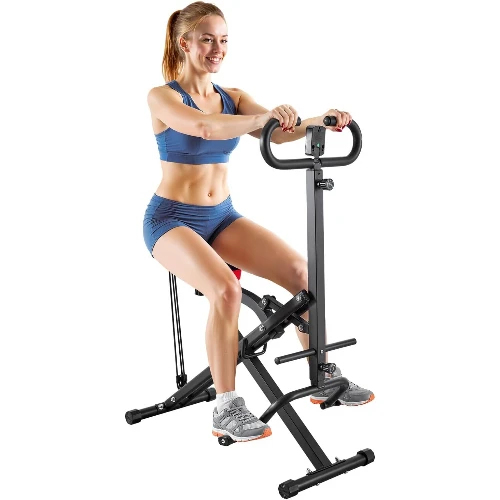
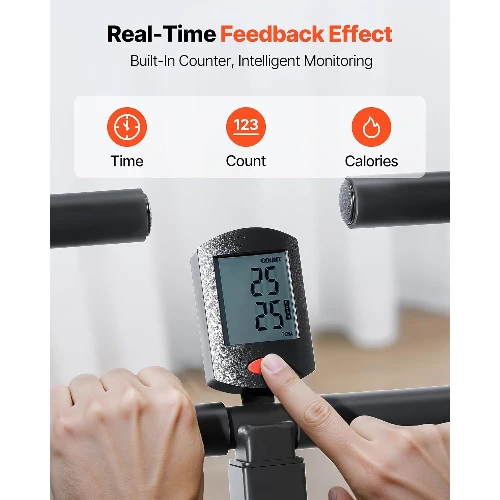
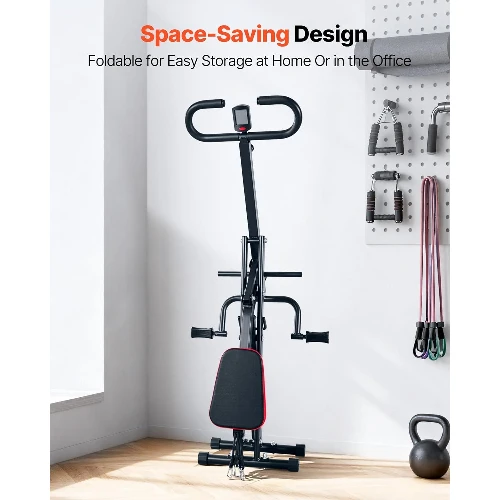
Two Movement Patterns, One Frame That Folds Away
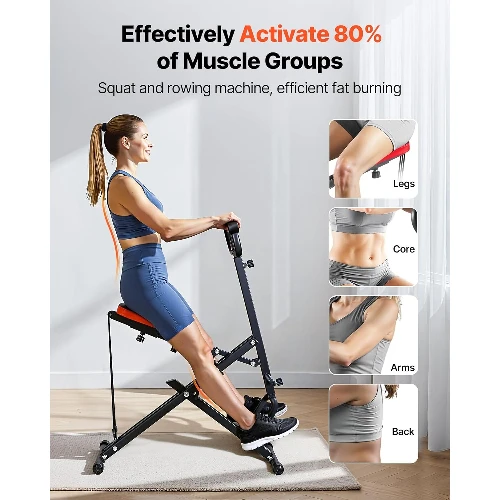
Almost everything the lower body does comes down to two patterns: a squat and a hip hinge, with a horizontal pull for the back. This frame supports a guided deep squat and a seated row, both loaded by elastic bands. Band resistance behaves differently from a barbell — it’s an ascending resistance curve, so tension rises as the band stretches. That means it is lightest at the bottom of a squat, where you are mechanically weakest, and heaviest at lockout, where you are strongest. That curve suits joints kindly and matches your natural strength profile. The trade-off is that bands are poor for building maximal strength; they’re excellent for volume, hypertrophy, and mobility under load.
Key Benefits
- Guided deep squat with support — the frame lets you sit into a genuinely deep squat and load it, which most people cannot do freestanding without folding forward.
- Band resistance is joint-friendly — tension is lowest at the bottom of the range, where knees and hips are most vulnerable, and highest at the top.
- Rowing pattern trains the back you actually neglect — desk-based lives underwork the rhomboids and mid-trapezius; a rowing motion loads them directly.
- Folds flat between sessions — the reason most home equipment fails isn’t quality, it’s that it lives in the way and gets resented.
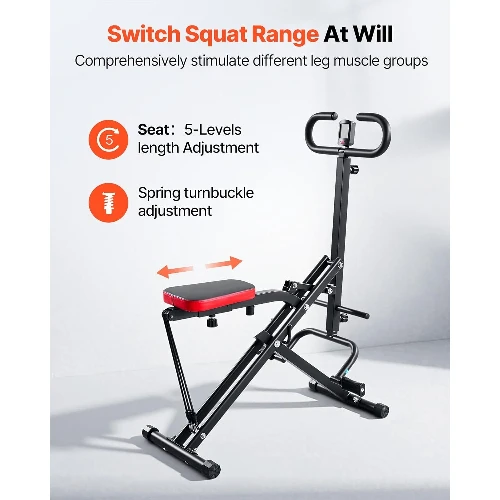
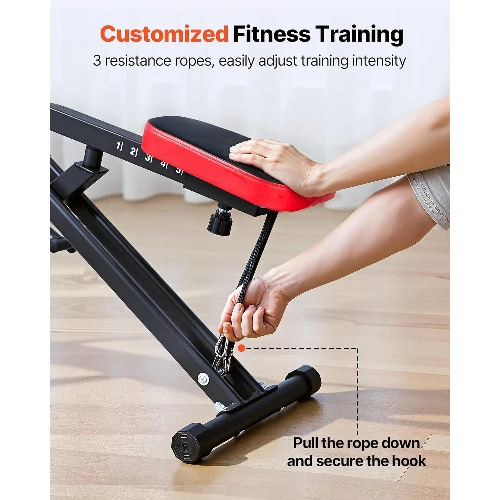
- Adjustable load by swapping bands — progressive overload without buying plates, and easy to dial down on a low-energy day.
- Not a substitute for a barbell — if your goal is a heavy one-rep max, bands will get you a long way and then stop. For conditioning, glute work, and joint-friendly volume, this is ideal.
How to Use
Unfold the frame on a flat, non-slip floor, click the bands into place, and check the frame is fully locked before you load it. For squats, keep your feet flat, drive your knees out in line with your toes, and control the descent for two to three seconds rather than dropping into the bottom. For rows, keep your chest tall and pull with your elbows, squeezing your shoulder blades together at the finish. Safety: inspect every band before every set — run it through your fingers and look for nicks, tears, or thinning, because a band that snaps under load releases all its energy at once. Never stretch a band toward your face, never over-stretch beyond the manufacturer’s stated limit, and never leave a loaded band unattended. Confirm the folding joints and pins are fully seated before each session.
Specifications
| Type | Foldable squat and row trainer with resistance bands |
|---|---|
| Bands included | 2 or 3 high-strength bands, variant dependent |
| Movements | Deep squat, seated row, glute and leg work |
| Frame | Steel, folding |
| Resistance | Adjustable by band selection |
| Storage | Folds flat |
| Assembly | Minimal — unfold and lock |
| User weight limit | See product attributes |
Care & Maintenance
Wipe the frame down after use — sweat corrodes steel, and the joints are where it shows first. Inspect the bands before every session and retire any band with a visible nick, tear, or thin section; they fail suddenly, not gradually. Store bands away from direct sunlight, heat, and oil, all of which degrade latex. Check bolts and folding pins monthly and re-tighten. If a band anchor point is bent, cracked, or loose, stop using the machine until it is fixed.
What’s in the Box
1 × foldable squat/row frame, 2–3 high-strength resistance bands (count is variant dependent), and an assembly guide.
Reviews
There are no reviews yet.