
If you are buying compression socks for travel, standing shifts, running or general leg fatigue, 15–20 mmHg is the range you want. 20–30 mmHg is medical-grade compression and is worth a conversation with a clinician before you buy it. Most people who find compression socks unbearable bought a class too strong, or sized them by shoe size instead of calf circumference.
Compression socks are sold with a number on the packet that almost nobody explains. That number — measured in millimetres of mercury, or mmHg — is the pressure the sock applies at the ankle. It is the single most important thing on the label, and it is the reason two socks that look identical can feel completely different on your leg.
Here is what each range is actually for.
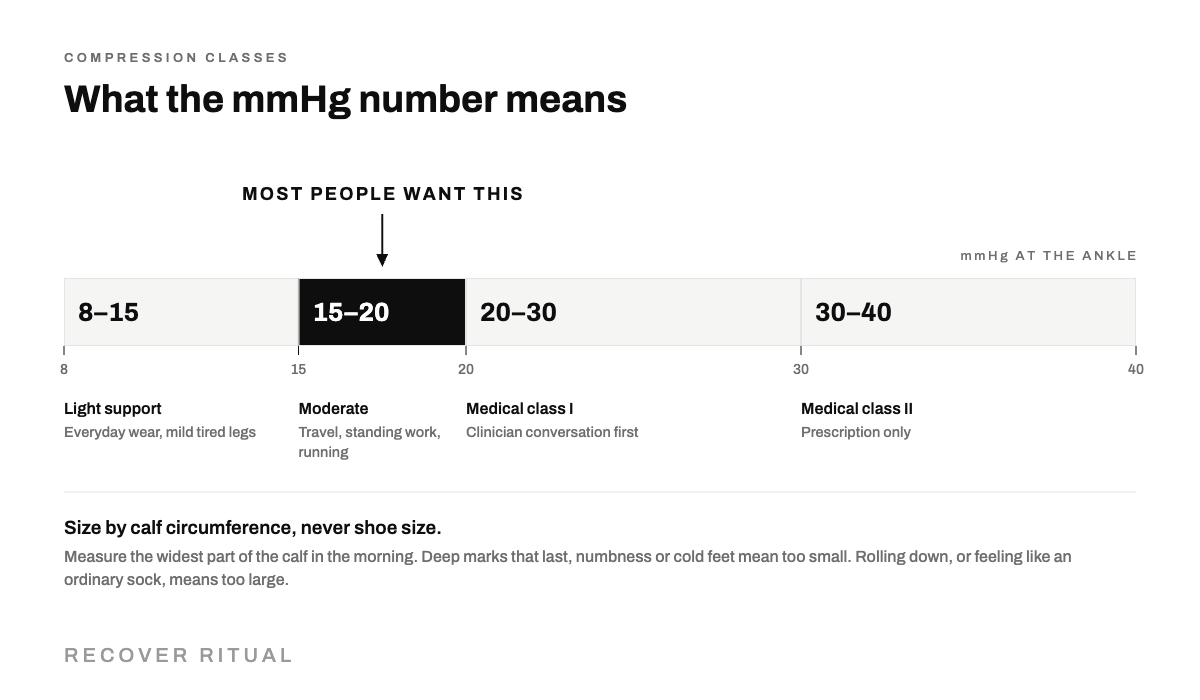
What the mmHg ranges mean
| Range | Commonly called | Who it is for |
|---|---|---|
| 8–15 mmHg | Light support | Mild tired-leg relief and everyday wear. Gentle enough that most people barely notice it. Often not enough to make a difference on a long flight. |
| 15–20 mmHg | Moderate / over-the-counter | The default for travel, standing work, running and recovery. Noticeable but comfortable for a full day. This is what most people are actually looking for. |
| 20–30 mmHg | Firm / medical class I | Prescribed contexts — varicose veins, significant swelling, post-surgical use, lymphoedema management. Effective, but genuinely tight, and worth clinical advice first. |
| 30–40 mmHg | Medical class II | Clinician-directed only. Not something to self-select. |
The word “graduated” matters too. A graduated sock is tightest at the ankle and eases as it goes up the calf. That gradient is what encourages blood back toward the heart. A sock that is uniformly tight all the way up is not doing the same job, and a sock that is tighter at the top than the bottom can act like a tourniquet.
Why sizing goes wrong so often
Compression socks are sized by calf circumference, not shoe size. This is the most common mistake we see, and it is why so many reviews say a sock “cut into my leg” or “fell down by lunchtime.”
Measure the widest part of your calf, first thing in the morning before any swelling has built up, and match that number to the brand’s chart. Two signs you got it wrong:
- Too small: deep indentations that stay for more than a few minutes, cold or tingling feet, or a top band that digs in like a rubber band.
- Too large: the sock rolls down, wrinkles behind the knee, or feels like an ordinary sock. It is not delivering the pressure on the label.
Moderate compression, 15–20 mmHg
Socks, sleeves, or open-toe?
These are three different products solving three different problems.
- Full compression socks cover the foot and calf. This is what you want if swelling in the ankles and feet is the issue — a footless sleeve does nothing for the foot.
- Calf sleeves are footless, so you wear your own socks with them. Runners prefer these for racing: you keep your favourite running socks and still get calf compression.
- Open-toe stockings suit anyone who finds closed compression too tight across the toes, and they make it easier to check circulation in the foot. Some people also find them easier to get on.
There is also a practical variant worth knowing about: zipper compression socks. Getting firm compression on is genuinely hard if you have limited grip strength, arthritis, or trouble reaching your feet. A side zip solves that, and it is the reason they exist.
How long should you wear them?
Graduated compression is designed for when you are upright and active — walking, standing, flying, training. Put them on in the morning before swelling builds, and take them off at night. Unless a clinician has specifically told you to sleep in them, do not: lying down changes the pressure dynamics they were designed around.
For recovery after a hard session, an hour or two afterwards is the usual approach. There is reasonable evidence that compression reduces the sensation of muscle soreness. The evidence that it meaningfully speeds up physical recovery is much weaker, and worth being honest about.
What compression does not do
Copper-infused, bamboo-charcoal and far-infrared compression garments are all sold at a premium. The compression in them works exactly as well as the compression in a plain nylon-spandex sock at the same mmHg — because the compression is doing the work. There is no good evidence that copper ions or infrared-emitting fabric add a therapeutic effect through skin. If you like the fabric, buy it for the fabric.
Compression also does not treat the underlying cause of swelling. New, sudden, or one-sided leg swelling — particularly with pain, warmth or redness in one calf — needs medical assessment rather than a sock, because those are the signs of a blood clot.
Common questions
What mmHg compression socks should I buy for flying?
15–20 mmHg is the standard recommendation for air travel. It is firm enough to help with the leg swelling that comes from sitting still in a pressurised cabin, and comfortable enough to keep on for a long-haul flight. Put them on before you leave for the airport rather than once you are seated.
Can I sleep in compression socks?
Generally no. Graduated compression is designed to work against gravity while you are upright, and the pressure gradient does not do the same job lying down. If a clinician has prescribed overnight compression for a specific condition, follow their instruction instead.
How do I know if my compression socks are too tight?
Deep indentations that persist for more than a few minutes after removal, numbness, tingling, or feet that feel cold or look pale are all signs the sock is too small or the compression class is too high. Compression should feel like firm, even support, not like a constriction.
Do compression socks help with varicose veins?
Compression is a standard part of managing varicose vein symptoms and can reduce aching and swelling. It does not remove existing varicose veins. If a clinician has raised varicose veins with you, ask which compression class they want you in before buying 20–30 mmHg yourself.
How often should compression socks be replaced?
Every three to six months with regular wear. The elastane that creates the pressure degrades with washing and time, and a sock that has gone slack is no longer delivering its rated compression even though it looks fine. Cold wash and air dry to make them last — tumble-dryer heat is what kills them fastest.
This guide is general information, not medical advice. Compression above 20 mmHg, and compression for any diagnosed circulatory condition, should be discussed with a clinician who can assess your legs.