They are not competitors. A foam roller applies broad, sustained pressure using your own body weight — good for large muscles, calves, quads and the upper back, and good for a slow warm-up or cool-down. A massage gun applies fast, concentrated percussion in a small area — better for reaching a specific tight spot quickly, and far easier to use on yourself. If you can only buy one, buy the foam roller first. It is cheaper, needs no battery, and covers more of your body.
Both tools are doing something similar in principle: applying mechanical pressure to muscle and connective tissue to reduce the sensation of tightness and improve short-term range of motion. The research on both is honestly quite modest — the reliable, repeatable finding is a temporary improvement in flexibility and a reduction in perceived soreness. Neither tool breaks up scar tissue, flushes lactic acid, or lengthens fascia, whatever the marketing says.
Where they genuinely differ is in how you apply that pressure, and that difference decides which one suits you.
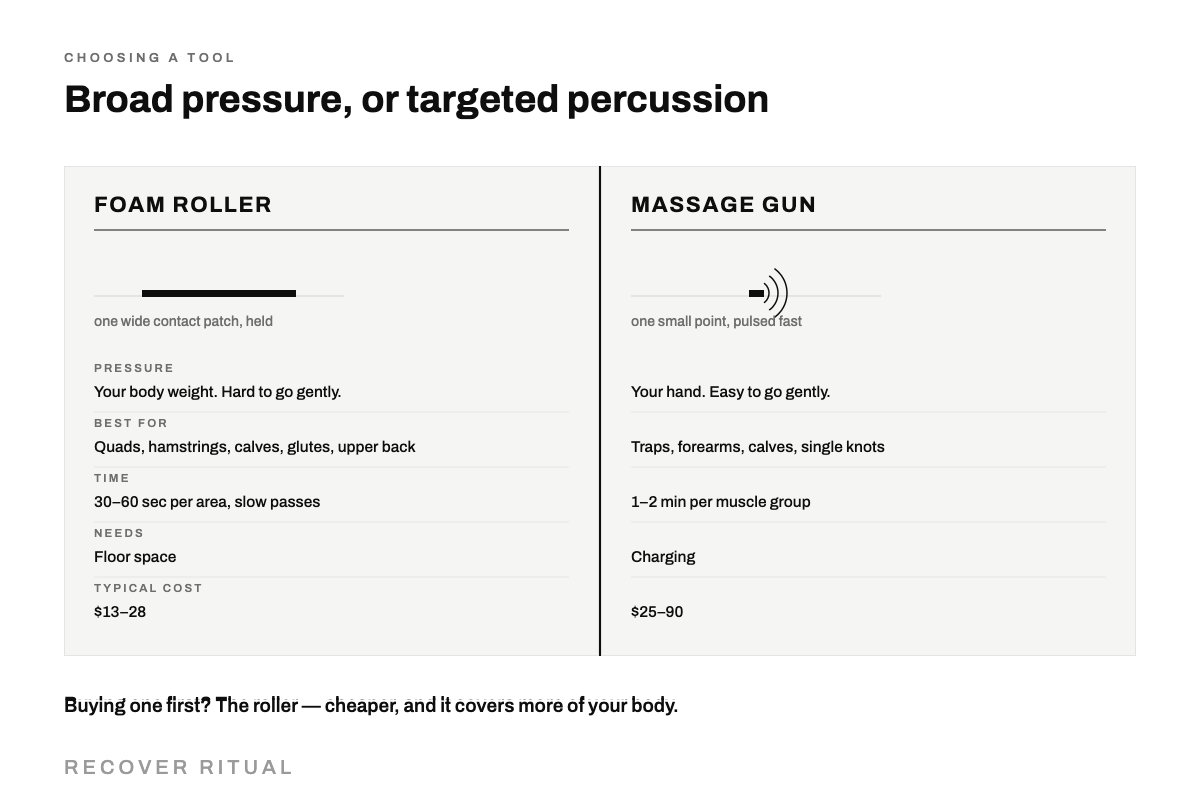
How they compare
| Foam roller | Massage gun | |
|---|---|---|
| Pressure | Broad and sustained. You control it with body weight, which is hard to do gently. | Concentrated and rapid. You control it with hand pressure, which is easy to do gently. |
| Best for | Quads, hamstrings, calves, glutes, upper back, IT band area | Traps, forearms, calves, specific knots, awkward-to-reach spots |
| Effort | You get on the floor and hold your own weight | You sit still and hold a device |
| Time | 30–60 seconds per area, slow passes | 1–2 minutes per muscle group |
| Noise / battery | Silent, no charging | Audible, needs charging |
| Travel | Bulky unless collapsible | Mini models fit a gym bag |
| Typical cost | $13–28 | $25–90 |
When the foam roller is the right answer
Rolling is the better tool when the area you want to work is large and you want a slow, general loosening rather than a targeted release. It is also the honest choice for anyone building a first recovery setup: it is inexpensive, indestructible, and there is nothing to break or charge.
The main thing people get wrong is speed. Rolling quickly back and forth feels productive and does very little — the tissue does not have time to respond. Move slowly, and when you find a tight spot, stop there and hold for twenty to thirty seconds while breathing normally.
The second thing people get wrong is firmness. A textured or hollow-core roller like the grid foam roller is considerably firmer than a soft solid one, and it is not a good first roller. If you are new to this, start softer — a basic EPP hollow roller is plenty — and progress when the pressure stops registering.
Foam rollers
When the massage gun is the right answer
A massage gun wins on two things: reach and control. Getting a foam roller onto your own trapezius or forearm is awkward at best. A gun gets there in seconds, and because you control the pressure with your hand rather than your body weight, you can go genuinely light on a sensitive area — something a roller makes very hard.
It is also faster. One to two minutes per muscle group is enough, which is why guns get used before training as much as after. That is a real practical advantage if the reason you skip recovery work is that it takes too long.
Size matters more than the spec sheet suggests. A mini massage gun has a shorter stroke and suits calves, forearms and the neck-adjacent muscles. If you mainly want to work glutes and quads, a full-size unit like the deep tissue model will actually be felt where a mini will not.
Where not to use a massage gun
This matters more than with a roller, because the force is concentrated. Keep it off bone, off the spine, off the front and sides of the neck, and off the abdomen. Do not use it over a bruise, a swollen area, a recent injury, a suspected fracture, or an area where sensation is reduced. If you are on blood thinners or have a clotting disorder, ask a clinician first.
Massage guns
The tool most people actually need
If the problem is one specific spot — the arch of your foot, a knot under the shoulder blade, the outside of your hip — neither a roller nor a gun is ideal. A massage ball is. It costs less than both, gets into places a roller cannot reach, and lets you control pressure precisely by working against a wall instead of the floor.
A sensible order for building a setup, if you are starting from nothing: roller first, ball second, gun third.
Common questions
Is a massage gun better than a foam roller?
Neither is better in general — they apply pressure differently. A foam roller gives broad, sustained pressure over large muscles and costs less. A massage gun gives fast, targeted percussion and reaches areas you cannot easily roll. Most people who own both use the roller for legs and back and the gun for shoulders, neck and forearms.
How long should you use a massage gun on one muscle?
One to two minutes per muscle group. Spending longer on a single spot tends to increase soreness rather than reduce it. Move the gun continuously rather than holding it in one place.
Should you foam roll before or after a workout?
Both work, for different reasons. Before training, rolling briefly improves short-term range of motion without reducing strength. After training, it reduces the sensation of soreness over the following days. If you only do one, do it after.
Does foam rolling break up scar tissue or fascia?
No. The forces you can generate with body weight on a foam roller are nowhere near enough to deform fascia or break down scar tissue. The effects that do show up in research are neurological and short-term: reduced pain sensitivity and improved tolerance to stretch.
Can you use a massage gun every day?
Short daily sessions on healthy muscle are fine for most people. Keep each muscle group to a couple of minutes, avoid bone and the spine, and stop if you get bruising, numbness or increased pain rather than relief.
General information, not medical advice. Persistent pain, or pain that follows a specific injury, should be assessed by a clinician rather than treated with a recovery tool.